
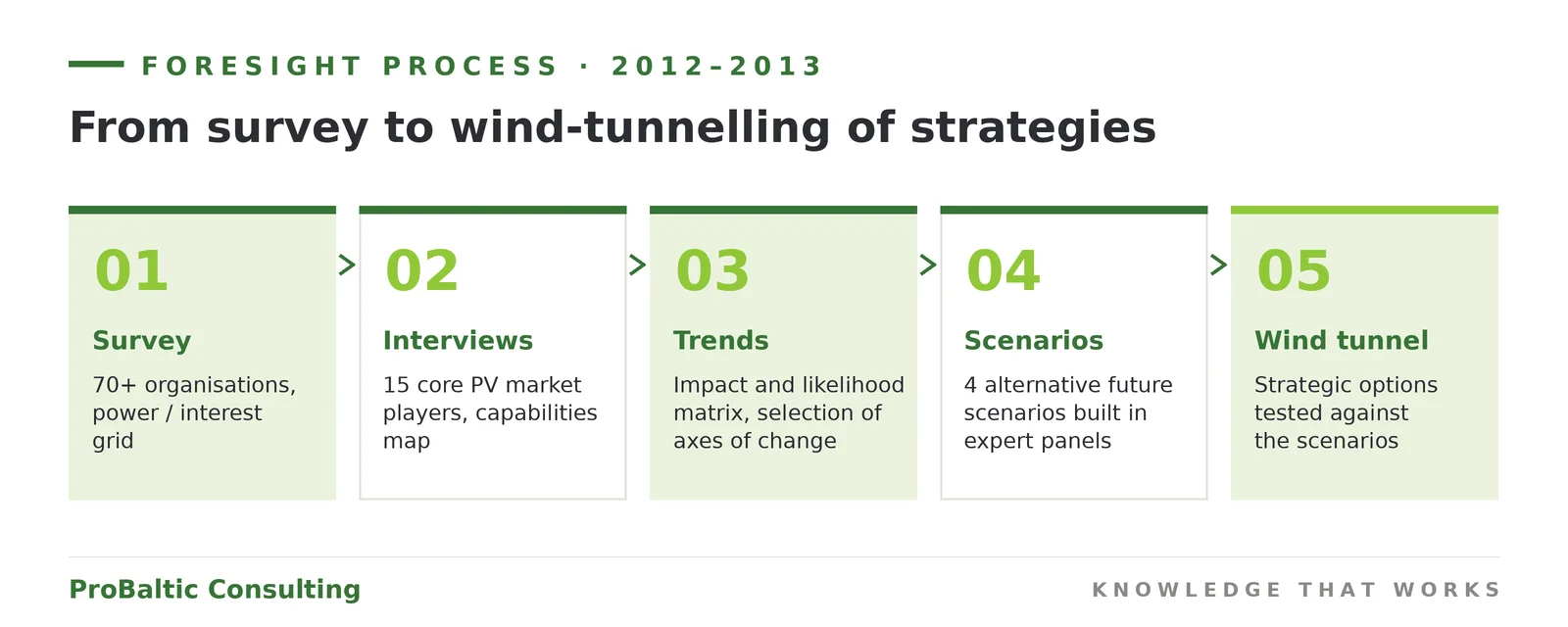
In 2012–2013, ProBaltic Consulting, together with the Lithuanian Photovoltaic Technology Cluster, prepared a future foresight of the Lithuanian photovoltaic (PV) sector with a 2025 horizon. Four alternative future scenarios were built — not forecasts, but alternative future realities used to “wind-tunnel” the sector strategy: it had to work in every one of them. With 2025 behind us, we have a rare opportunity to see which imagined directions and trends held up — and which did not.
| Client | Photovoltaic Technology Cluster |
|---|---|
| Field | Future scenarios (foresight), sector strategy |
| Years | 2012–2013 · horizon — 2025 |
| Methods | Survey of 70+ organisations (69 respondents from business, academia and public policy); power / interest grid; 15 in-depth interviews; capabilities map; trend impact and likelihood matrix; scenario building in expert panels; “wind-tunnel” testing of strategies |
| Result | 4 alternative future scenarios and a sector strategy robust across all of them |
Scenarios: alternative future realities, not a forecast
The core methodological principle: scenarios are not a guess about the future. They are alternative narratives about possible future contexts whose purpose is to test strategic decisions: does the chosen strategy remain sound in each possible future? The four scenarios were built along two axes of change — free market versus a regulated environment, and incremental versus radical technology change. Accordingly, reviewing them a decade later is about directions, not numbers: which driving forces actually operated.
The four scenarios
The scenarios built in the expert panels covered the full field of the axes of change — from free market to regulated environment, from incremental to radical technology change:
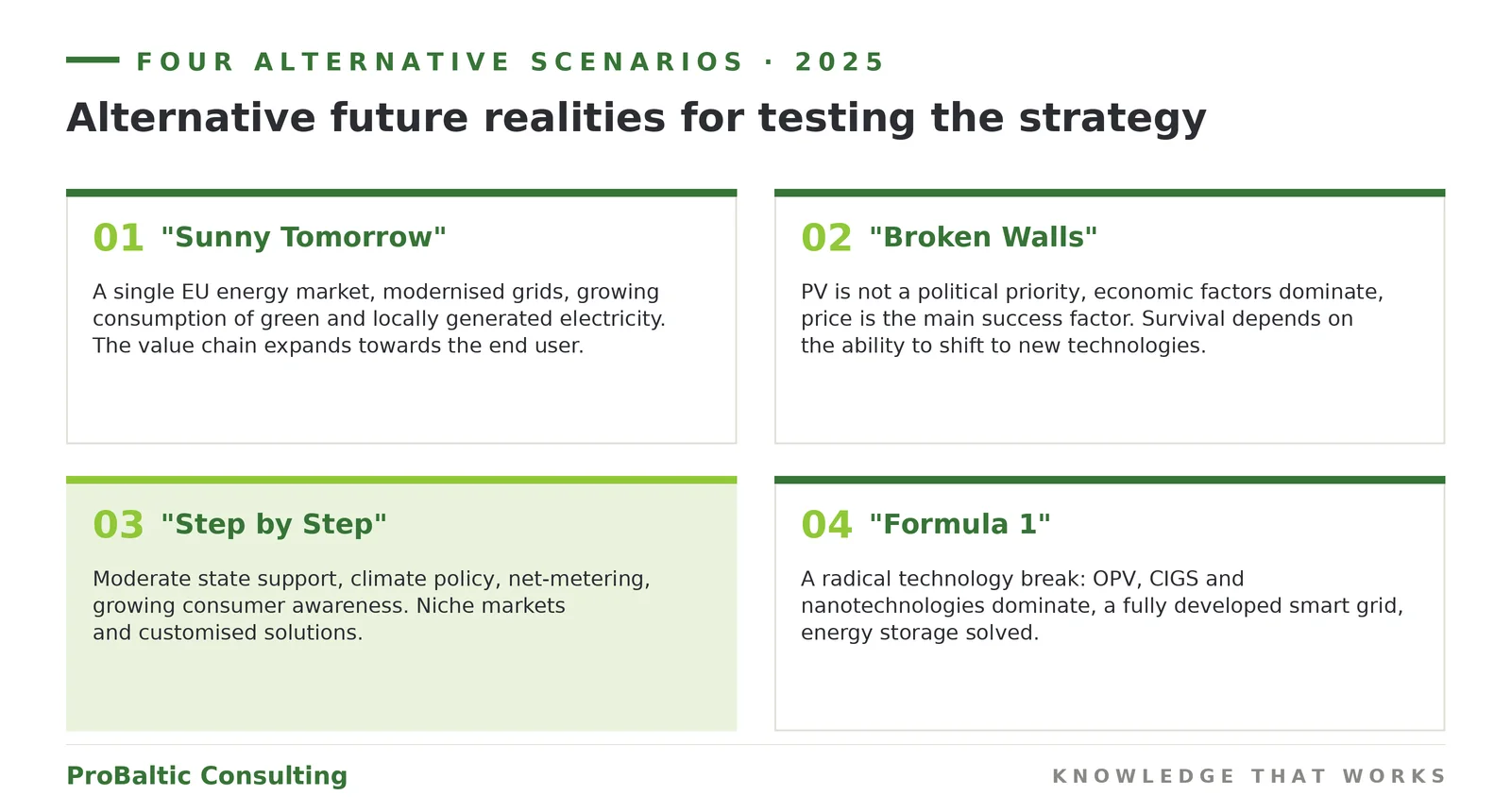
For each scenario the experts formulated strategic choices and assessed how well they held up in the other scenarios. The same directions recurred in all four: science–business collaboration, competence and human-resource development, niche markets and customised solutions (including building-integrated photovoltaics — BIPV), strengthening value-chain links and specialisation, and fixing the legal framework (net-metering). These directions that “survived” every scenario formed the backbone of the strategy.
Checking the directions and trends
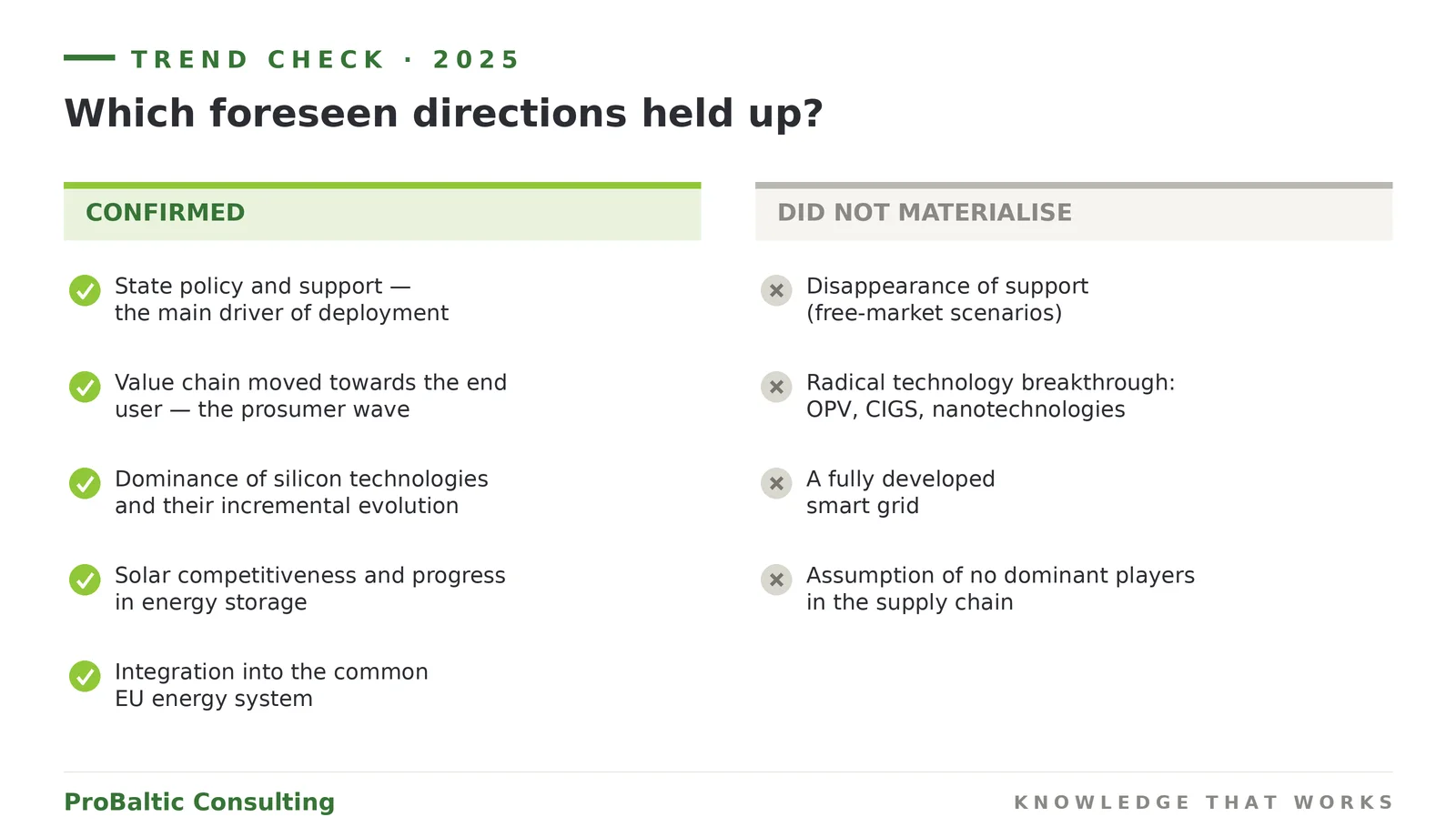
| Area | Foreseen direction | Reality by 2025 |
|---|---|---|
| Driver of development | “Step by Step”: continued state support, climate and energy-independence policy, growing consumer interest. | Deployment was indeed driven by consistent state policy, support measures and the prosumer model. Direction confirmed. |
| Moving towards the end user | In all scenarios the value chain moves closer to the end consumer. | The prosumer wave became a defining feature — decentralisation went even deeper than imagined. Direction confirmed. |
| Technology | Silicon modules remain dominant with incremental evolution; radical scenarios expected OPV, CIGS and nanotechnology breakthroughs. | Crystalline silicon still dominates, improving evolutionarily; no radical technology break occurred. Trajectory confirmed; efficiency progress faster than expected. |
| Costs and storage | PV becomes competitive, installation costs fall, storage solutions improve. | Solar became one of the cheapest forms of new generation, and storage became widely accessible. Direction confirmed; the change came faster than assumed. |
| EU market and grids | “Sunny Tomorrow”: a single EU energy market and grids adapted to solar and wind; “Formula 1” — a fully developed smart grid. | The Baltic states synchronised with continental Europe, but grid capacity became the main constraint on further growth. Integration confirmed; grid readiness overestimated. |
| Supply chain | An assumption that raw-material and supply-chain players would not gain a dominant position. | Global module manufacturing concentrated heavily in a single country. Not confirmed — geographic concentration received too little attention. |
| Pace of growth | All scenarios envisaged gradual solar deployment. | Deployment was exponential and far exceeded the scale imagined in any scenario. Pace underestimated — a classic foresight failure mode, where exponential technology cost decline is intuitively converted into linear growth. |
What this means for strategy
The 2025 reality blended elements of several scenarios: mostly “Step by Step” (support, regulation, incremental silicon evolution), partly “Sunny Tomorrow” (EU system integration, solar competitiveness). The free-market “Broken Walls” environment and the radical-technology “Formula 1” environment did not materialise. This is exactly what scenarios are for: without knowing in advance which future will arrive, the strategy must work in all of them. Sector players whose strategy rested on the directions recurring across every scenario — moving closer to the end user, advancing silicon technologies, making full use of support instruments — chose correctly in any of the possible futures.
The foresight correctly identified the key driving forces: policy and regulation, falling costs, energy independence, consumer engagement, silicon dominance and the importance of storage. Its weakest points were underestimating the pace of growth and the concentration of the global supply chain. A valuable lesson for future foresights: directions are easier to foresee than scale.
Need scenarios or a foresight for your sector?
Since 2007, ProBaltic Consulting has delivered future foresights, scenarios and strategic evaluations for the public sector and business — from methodology to expert process management. Learn about our studies and foresight services or get in touch.