
Working in a consortium with the Research and Higher Education Monitoring and Analysis Centre (MOSTA, now STRATA), ProBaltic Consulting developed and implemented a future foresight methodology that produced the officially adopted Lithuanian research and higher education vision 2030. It was the first methodologically rigorous future foresight exercise in Lithuania: a foresight of this scope had never been carried out in the country before, and it followed a documented methodology aligned with international practice.
| Client | Research and Higher Education Monitoring and Analysis Centre (MOSTA) |
|---|---|
| Field | Future foresight, strategic planning |
| Project | MOSTAF — EU structural funds project |
| Methodological partner | Fraunhofer Institute for Systems and Innovation Research (ISI, Germany) |
| Years | 2010–2011 |
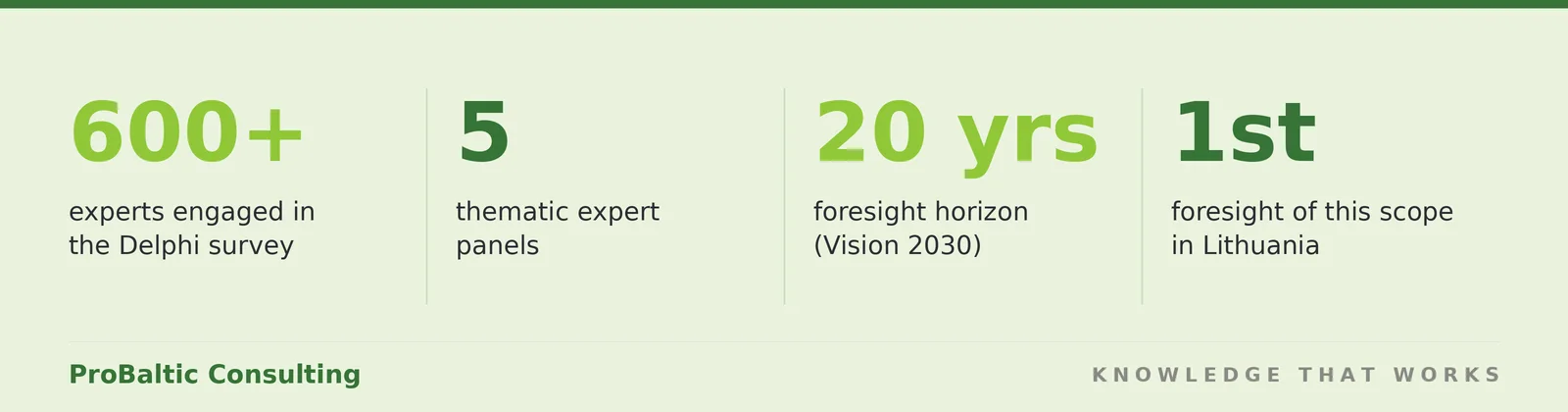
| Scope | 5 thematic expert panels · Delphi survey of ~600 experts · 20-year horizon |
| Services provided | Foresight methodology development; management, coordination and communication methodology; expert panel facilitation; Delphi survey; scenario and vision-building process management |
Why it was the first methodologically rigorous foresight in Lithuania
Before this project, no future foresight of comparable scope had been prepared in Lithuania under a pre-documented methodology. The project methodology states it directly: “a foresight of this field and scope is being carried out in Lithuania for the first time” — which is why process quality was assessed against fidelity to the foresight methodology rather than expectations. Together with Fraunhofer ISI, following a normative approach, a three-part methodological framework was prepared: the foresight development methodology, its implementation plan, and the management, coordination and communication methodology.
Challenge
Lithuania’s research and higher education system needed a long-term development vision and measurable objectives whose implementation could become the object of systematic monitoring. The foresight had to cover a 20-year horizon, generate several alternative scenarios, distil the preferred vision, and produce a strategic agenda to 2030 with checkpoints in 2015, 2020 and 2025 — while engaging the widest possible circle of stakeholders so the vision would live on rather than become a shelf document.
Solution: a five-stage foresight process
The foresight architecture was built on the expert working group method, complemented by a broad external expert survey. Five thematic expert panels (10–15 experts each) were formed: the Lithuanian research and higher education context; Lithuania in the international context; the system and knowledge flows; lifelong learning and human capital; and research, studies and society.
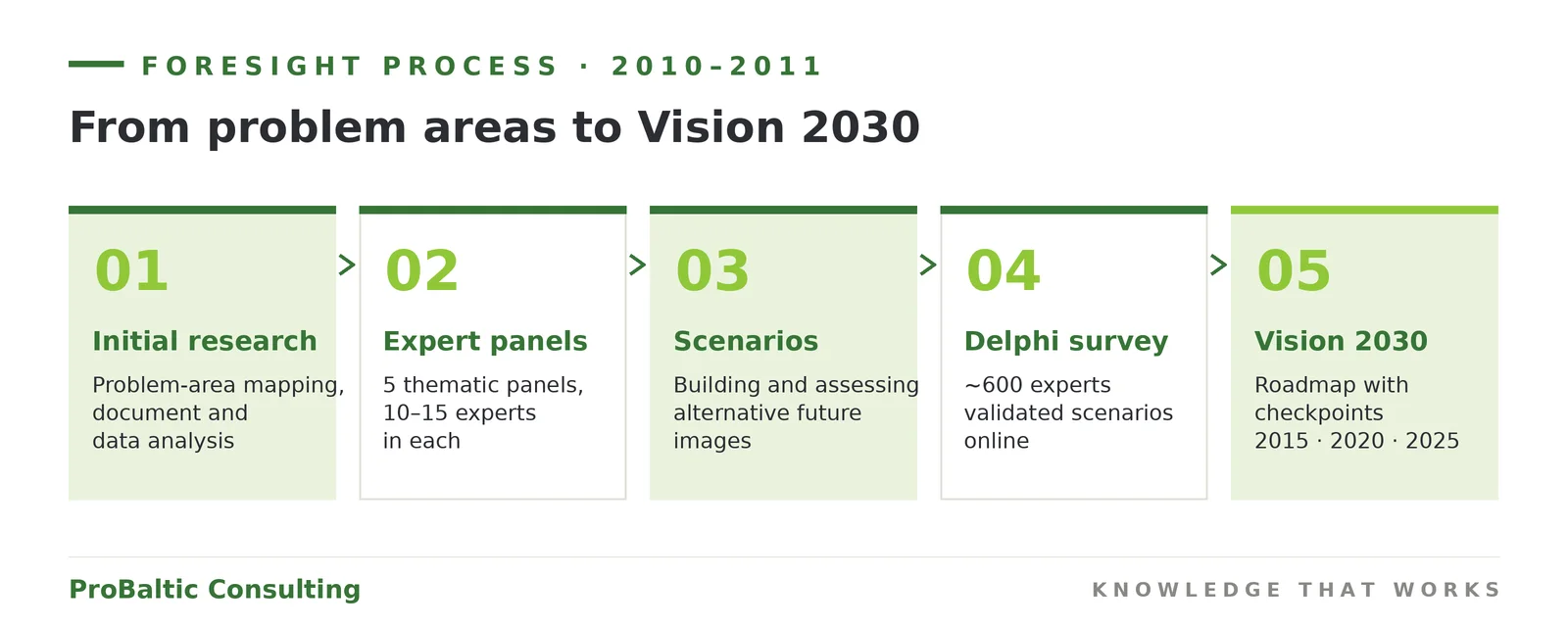
Alternative future images and scenarios created in the panels were tested against three criteria: plausibility (the scenario stays within the bounds of credible events), consistency (its logical elements contain no internal contradictions) and decision-making utility (each scenario adds specific insight for the choices at hand).
Delphi survey: validation by ~600 experts
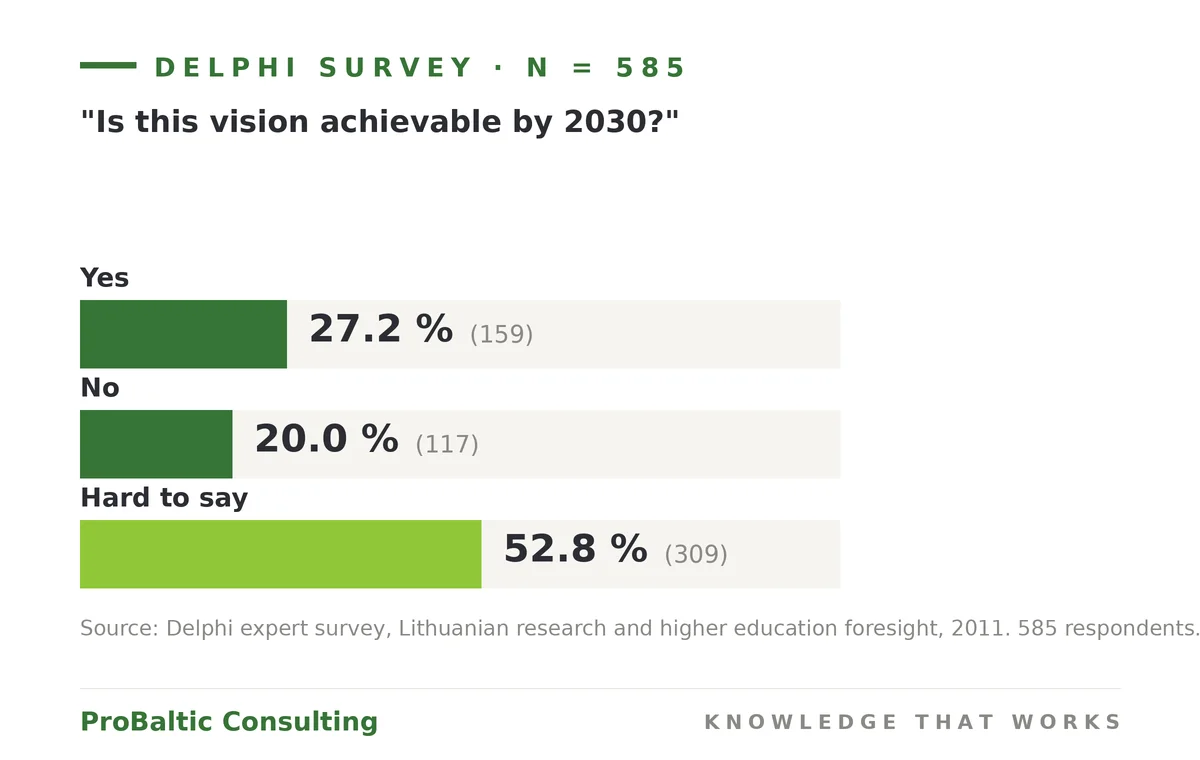
The vision was validated through an online Delphi-type survey of about 600 experts from research institutions, universities, colleges, business and civil society (585 responded). The results showed clear consensus on the substance of the vision — 73.5% of experts accepted it as the desired state for 2030:
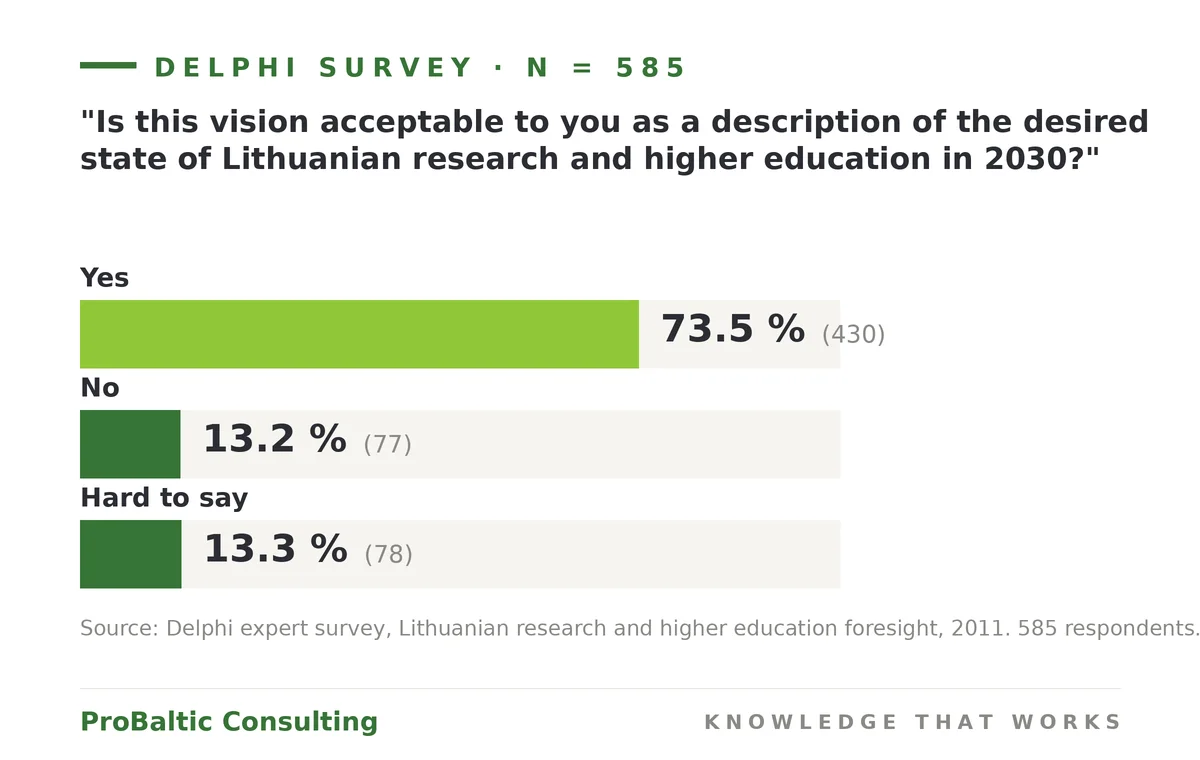
On whether the vision was achievable by 2030, however, uncertainty prevailed — more than half of the experts answered “hard to say”. Resolving that uncertainty was precisely the job of the next foresight stage: a strategic agenda with concrete measures and checkpoints in 2015, 2020 and 2025.
Results
- The long-term Lithuanian research and higher education development vision 2030 was prepared and officially adopted — the first methodologically rigorous future foresight in Lithuania;
- Long-term development objectives were formulated and became the object of the national monitoring and analysis system;
- The vision informed the setting of Lithuania’s research and higher education priorities and was linked to the national long-term progress strategy “Lithuania 2030”;
- A lasting network of experts and stakeholders was created — a long-term impact outliving the project itself;
- Foresight competence was established in Lithuania: a documented methodology transferable to other fields and organisations.
Need a foresight or strategic evaluation in your field?
Since 2007, ProBaltic Consulting has delivered studies, evaluations and future foresights for the public sector and business — from methodology design to expert process management and results communication. Learn about our studies and foresight services or get in touch to discuss your needs.