
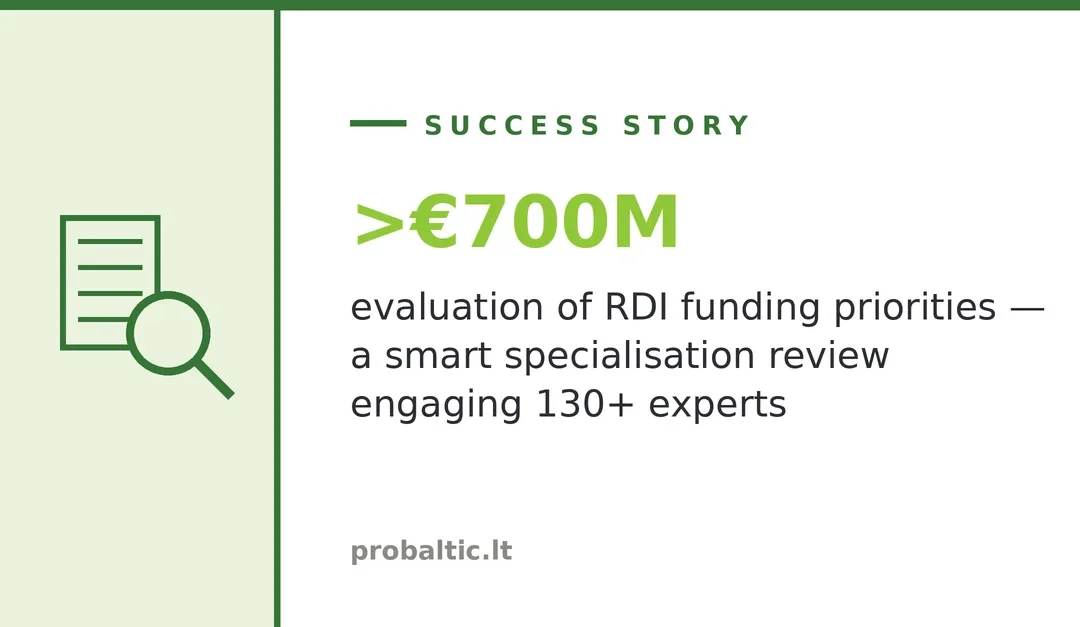
Commissioned by the Ministry of Economy of the Republic of Lithuania, in 2018 ProBaltic Consulting designed the methodology for and carried out the interim evaluation of the implementation of Lithuania’s smart specialisation (RDI) priorities for the 2014–2020 financial perspective — a programme worth over €700 million. More than 130 leading Lithuanian experts from business, academia and public institutions were engaged, and the evaluation’s recommendations became the basis for a real policy change — in 2020 the RDI priorities were consolidated into three.
| Client | Ministry of Economy of the Republic of Lithuania (now Ministry of the Economy and Innovation) |
|---|---|
| Field | Policy evaluation and design (RDI, smart specialisation) |
| Project | “Development and implementation of a system for setting research and innovation policy priorities” (2017 contract) |
| Programme | 2014–2020 smart specialisation priorities — over €700 million |
| Years | 2017–2018 · methodological support — 2019 |
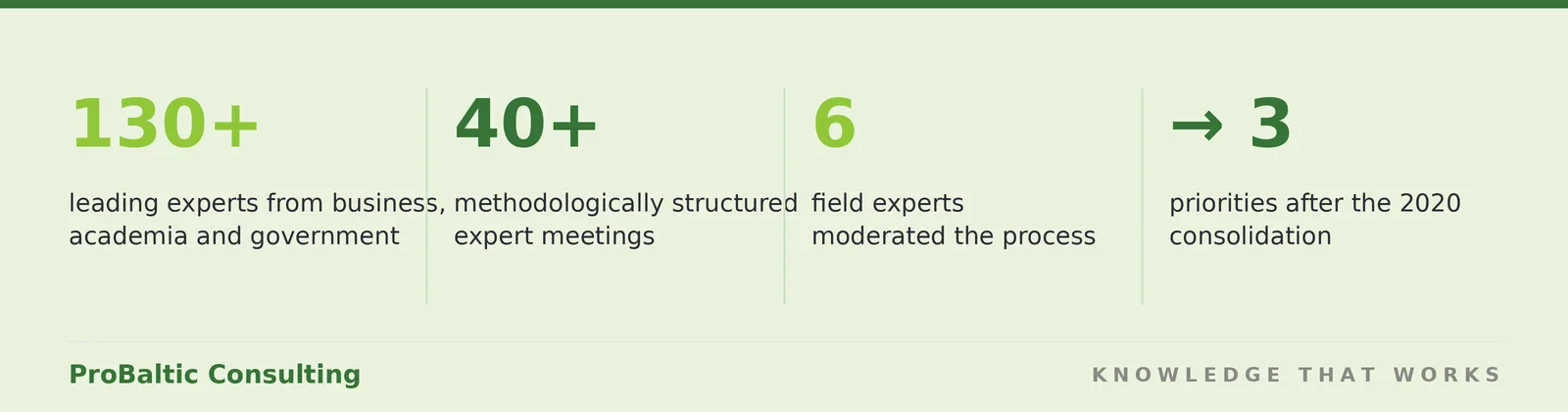
| Scope | 130+ experts · 40+ methodologically structured meetings · 6 field experts |
| Methods | Entrepreneurial discovery process (EDP); SWOT; priority ranking by capability and expected impact; alignment with global trends |
| Result | Updated priority descriptions and transformation recommendations that underpinned the 2020 consolidation of priorities |
Challenge: a broad programme, fragmented funding
Lithuania’s smart specialisation strategy covered most sectors of the economy, so limited funding was being handed out in small portions — a point later confirmed by the European Commission in its country report “Lithuania 2019”. The Ministry needed a methodologically consistent, expert-based evaluation: which priorities and technologies remained relevant, where capability and impact potential were greatest, and how to restructure the priorities without losing continuity. The evaluation was to complement official monitoring with an independent, bottom-up view of implementers and market participants.
Solution: the entrepreneurial discovery process (EDP)
The evaluation was built around the entrepreneurial discovery process (EDP) — the inclusive, interactive bottom-up method recommended by the European Commission’s S3 platform: participants from different backgrounds (policy, business, academia) surface expert knowledge about possible new activities, while policy makers assess the results and look for ways to realise the potential. Following a five-stage expert schema proposed by ProBaltic, more than 40 methodologically structured meetings took place, moderated by recognised experts of six fields: “Energy and sustainable environment”, “Transport, logistics and ICT”, “New production processes, materials and technologies”, “Health technologies and biotechnology”, “Agro-innovation and food technologies”, and “Inclusive and creative society”.
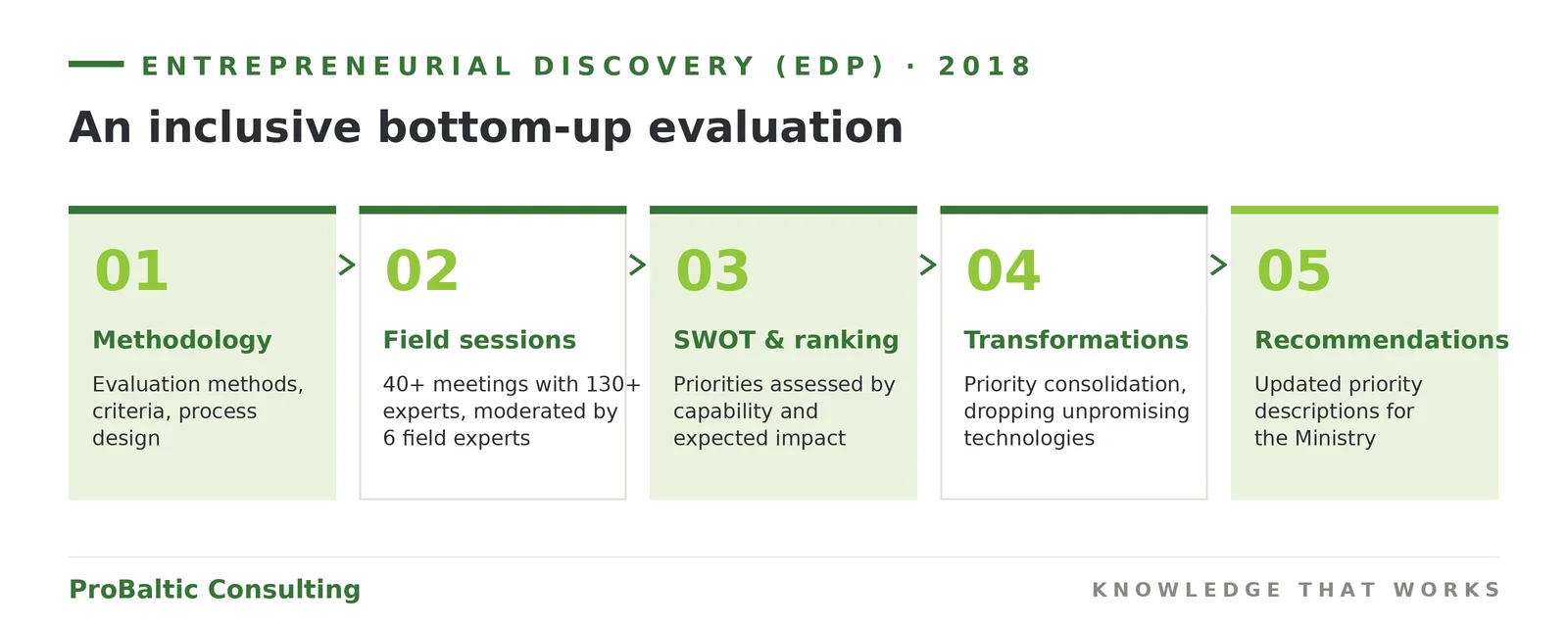
The relevance of priorities and technologies was assessed along two dimensions: alignment with global and European trends (market and technology shifts, growing demand) and Lithuanian organisations’ capability to exploit them through existing competitive advantage. Each priority was ranked by capability and expected impact criteria, complemented by SWOT analysis.
Key conclusion: challenges instead of technology lists
The experts agreed unanimously: overly detailed regulation of the programme — especially the “thematic specificity” criterion in project selection — was limiting implementation and impact. Programme documents should formulate the problems to be solved rather than name specific technologies: technologies fixed in documents in advance constrain innovation and rational competition between applications. The evaluation recommended adopting the logic common in international practice:
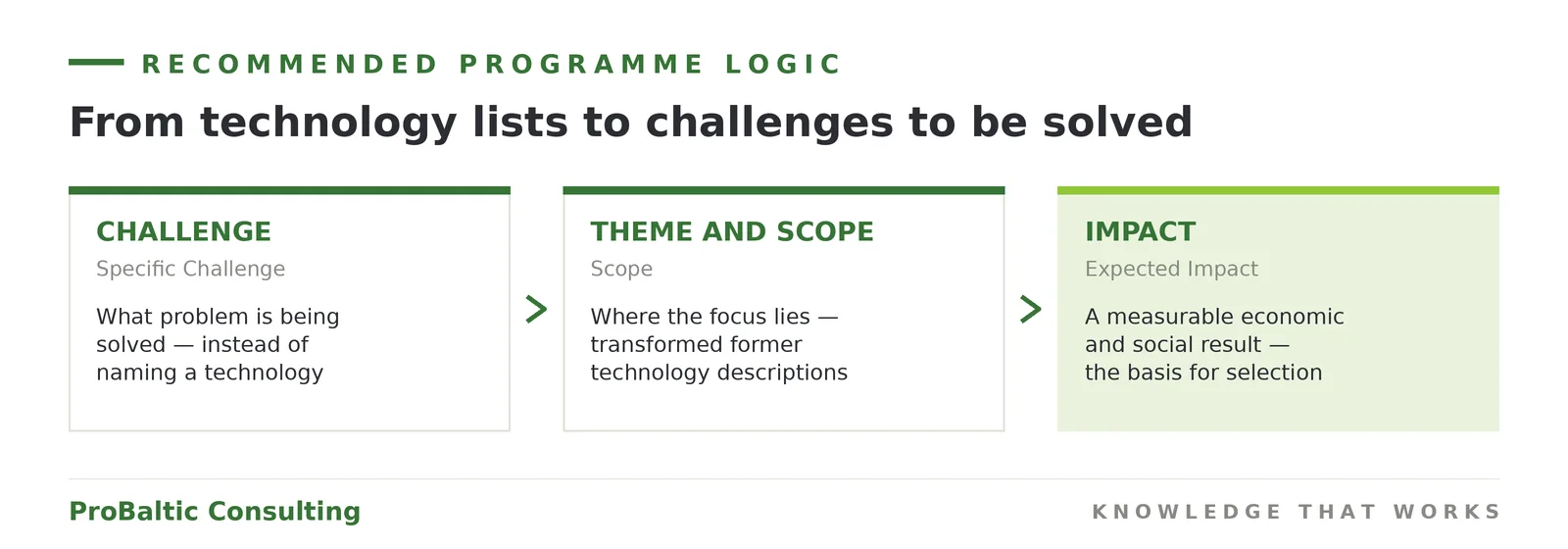
Three priority transformations were proposed to implement this logic: priority consolidation, concentrating resources on directions with the greatest potential and track record; dropping unpromising technologies and refining former priorities; and deepening the assessment of fit, replacing fragmented technological criteria with a combined evaluation of theme, scope and impact. The final updated priority descriptions were delivered to the client.
Policy impact: from recommendations to a decision
- In 2019 the evaluation’s recommendations informed the programme monitoring carried out by the Ministry of the Economy and Innovation together with the Government Strategic Analysis Centre;
- The direction of the conclusions was confirmed by the European Commission country report “Lithuania 2019”, which found the strategy “quite broad, covering most sectors of the economy, partly because of this the limited funding is being handed out in small portions”;
- On 11 June 2020 the RDI priorities coordination group decided to concentrate resources on the priorities creating the greatest added value — 3 RDI priorities were set in place of the previous fragmented structure: “New production processes, materials and technologies”, “Health technologies and biotechnology” and “Information and communication technologies”, integrating the most productive themes of the former priorities;
- A reusable EDP evaluation methodology was created and tested — a tool for periodic priority reviews.
Need help with policy evaluation or design?
Since 2007, ProBaltic Consulting has delivered programme and policy evaluations, designed evaluation methodologies and moderated inclusive expert processes for the public sector — from evaluation design to recommendations that turn into decisions. Learn about our studies, evaluations and foresight services or get in touch.
More about the EDP method — on the European Commission’s S3 platform: s3platform.jrc.ec.europa.eu.