The ProBaltic Method is a nine-stage, gated system that ProBaltic Consulting uses to take a company from a business challenge to a paid-out grant. Every finding is tied to a source, scores are forecast before the proposal is written, and a decision not to apply counts as a result of the method just as a submitted proposal does.
We have prepared EU funding applications since 2007, and they have helped clients secure more than €90 million in funding across 220+ funded projects. Over that time we have learned that an application is usually decided before its first sentence is written. What decides it is whether the right programme was chosen, whether the company really meets the conditions, and whether the project can score enough points. The text only shows what is already there.
So we wrote our work down as a method: nine stages, with a decision after each one on whether to go on. We apply it to every funding project, so all our consultants work the same way, and the client and its suppliers know in advance what will happen, what they need to provide and when decisions are made.
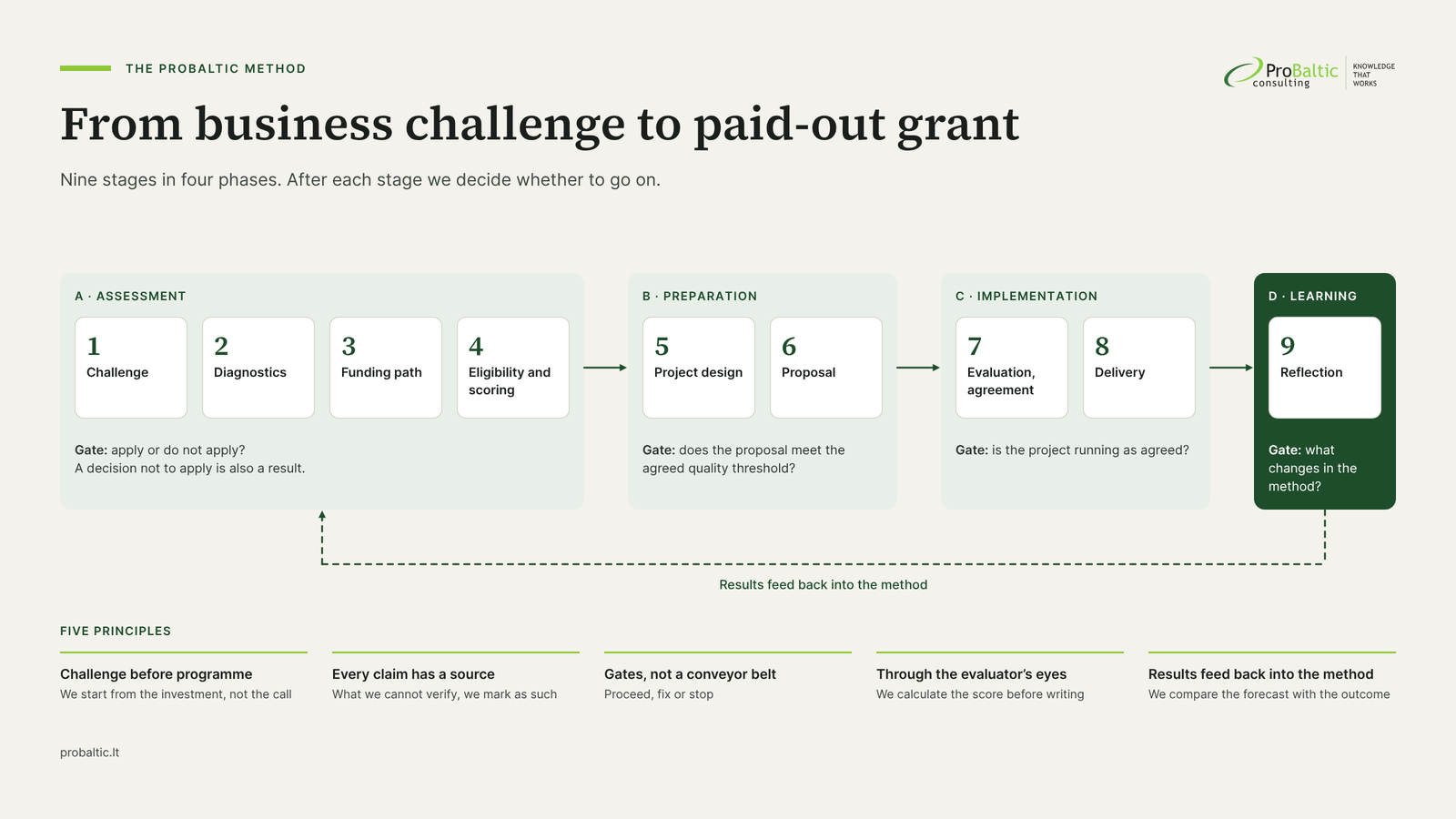
Four phases, nine stages
| Phase | Stages | What you receive | Decision at the gate |
|---|---|---|---|
| A. Assessment | 1. Challenge, 2. Diagnostics, 3. Funding path, 4. Eligibility and scoring | A readiness profile, a funding path map, an eligibility finding and a score forecast | Apply or do not apply |
| B. Preparation | 5. Project design, 6. Proposal | A project concept with a justified budget, and a submitted proposal | Does the proposal meet the agreed quality threshold |
| C. Implementation | 7. Evaluation and grant agreement, 8. Delivery | A grant agreement, payment claims, reports | Is the project running as agreed |
| D. Learning | 9. Reflection | Lessons from the project and the next step on the funding path | What changes next |
How we work
We start from the business challenge. The first question to a client is what challenge they are solving and what investment it takes. Which scheme to apply to comes later. Calls change every few months, while the need to invest stays. When a project is shaped to fit whatever call has opened, evaluators notice.
We check before we write. Company size is counted across the whole group. De minimis headroom is sometimes used up by a project the manager has forgotten. Work started a week too early can make the whole investment ineligible. We settle these points first, from registry data and the call documents, and state what each finding rests on. If we cannot verify something, we say so.
We calculate the score. In Lithuanian schemes a large share of the points depends on things that can be measured in advance: novelty level, revenue, partners, region. Before writing, we calculate the maximum score the project can reach. We know how schemes are designed and measured from our programme evaluation work.
Sometimes we advise not to apply. If the score falls short or the company fails a mandatory condition, we say so before the client spends money on an application, together with what would need to change or where to go instead.
We think about what comes after the agreement. A grant agreement is a commitment: indicators, procurement rules, years of durability. Before submitting, we review with the client whether they can meet all of it. A grant won and later recovered costs a company more than an application never filed.
We do not leave the project once it is submitted. We answer evaluators’ queries, oversee procurement, prepare payment claims and reports, and agree changes with the agency. The work is done when the full amount has been paid out.
We record how it ended. At the end of a project we compare our forecast with the score the project actually received. Where we were wrong, we correct our calculations. That is how the method changes.
Five principles
- Challenge before programme. We first define the business challenge you are solving. The programme is chosen for the challenge, and the project is not bent to fit a call.
- Every claim has a source. Eligibility findings rest on the call documents and on data about the company. What we cannot verify is marked “data missing”, not “eligible”.
- Gates, not a conveyor belt. Each stage ends in a decision: proceed, fix or stop.
- Through the evaluator’s eyes. Before writing, we calculate how many points the project can score. Before submitting, we assess the proposal the way the evaluation panel will.
- Results feed back into the method. Every project, won or lost, leaves a record that we use to refine our forecasts and the method itself.
What we check before you apply
The initial assessment covers five areas. A project moves forward only when none of them holds a blocking obstacle.
- Idea: the challenge addressed, novelty, technology readiness, market.
- Applicant: company size, financial health, de minimis headroom, sector of activity.
- Project: budget, own contribution, timeline, permits, partners.
- Programme: eligibility criteria, achievable score, competition, aid intensity.
- Obligations: indicators, durability period, procurement rules, risk of grant recovery.
A funding path, not a single application
We choose the programme along two axes: project maturity and complexity of participation. A company starts from what it is ready for. For some that is a national scheme, for others a directly managed EU programme from day one. The funding path map shows the first application and the step that follows it.
Not every client starts at stage one. Some come with a project already won that needs administering, others with a technology ready for a directly managed EU programme. We have prepared fourteen projects for a single client, so with every client we also discuss what comes after the first application.
The tool and the consultant
We use the eligibility tool app.probaltic.lt in every funding project. It automates part of the method, and where more client data or checks are needed, a consultant does the work.
| Stage | What the tool does | What the consultant adds |
|---|---|---|
| 2. Diagnostics | Collects public registry data: size, activity code, region, turnover, age, signs of financial difficulty | Group structure and SME status at the level of the linked enterprise, technology readiness, project data |
| 3. Funding path | Shows the open calls the company formally qualifies for | Chooses the programme for the business challenge and sets the order |
| 4. Eligibility and scoring | Checks formal criteria against the call documents and cites the source | Checks project eligibility, calculates the score, assesses the obligations |
What we expect from clients and suppliers
- From the client: one decision-maker for the project, data on time, and a decision at each gate.
- From suppliers and partners: the documents the application needs: dated, itemised and comparable quotes, technical specifications, partner data.
How the method improves
Every project ends with a reflection: we compare our forecast with the actual evaluation and record what decided the outcome. The method is reviewed periodically, and every change gets a version number.
Where the method applies
We apply the ProBaltic Method to our funding service, from business challenge to paid-out grant. For programme and policy evaluations we develop a separate methodology for each assignment.
For example, in 2017–2018 we reviewed Lithuania’s smart specialisation priorities for the Ministry of Economy; more than €700 million had been allocated to them for 2014–2020. For this we developed a separate methodology for assessing the relevance and, above all, the impact of R&D funding programmes. Its author and the methodological lead of the process was ProBaltic’s director, Mantas Jonauskis. The review drew on data from funded projects and on input from more than 130 experts from business, science and government, and in 2020 the priorities were consolidated into three. More about this evaluation. This is why we see a client’s project as more than an application: we know what impact the programme itself expects from the projects it funds.
Frequently asked questions
What is the ProBaltic Method?
A nine-stage, gated system that ProBaltic Consulting uses to take a company from a business challenge to a paid-out grant. We apply it to our funding service.
How is it different from ordinary grant writing?
We start from the business challenge, not from the call. We forecast the score before writing the proposal and back every eligibility finding with a source.
What does a decision not to apply mean?
If the project fails a mandatory criterion or the achievable score is too low, we say so before proposal work begins. We also state what would need to change or which programme would fit better.
Does every company go through all nine stages?
No. A company enters the method where it stands. For example, we take over an already funded project from the implementation stage.
How is the ProBaltic Method different from app.probaltic.lt?
The ProBaltic Method describes the whole funding service. App.probaltic.lt is a tool that automates part of it: diagnostics and the check of formal criteria. Its result is preliminary, and a consultant confirms the final eligibility finding.
Does the ProBaltic Method apply to studies and evaluations?
No. For programme and policy evaluations we develop a separate methodology for each assignment.
How much does proposal preparation cost?
If you decide to apply, proposal preparation is priced as a fixed preparation fee plus a success fee on the awarded grant.
Start with a check
Enter your company code and within 2–3 min. see which open calls your company formally qualifies for. If you decide to apply, proposal preparation is priced as a fixed preparation fee plus a success fee on the awarded grant.